

[Click to download the factsheet]
Myth: Nuclear plants expose nearby communities to dangerous radiation.
Plants are strictly regulated and continuously monitored. Routine radiation exposure from nuclear facilities is extremely low—often far below everyday background radiation from natural and medical sources. Federal regulations require plants to operate well within conservative safety limits, and independent agencies continuously track emissions to ensure public safety.
Myth: Used fuel cannot be safely managed.
Used nuclear fuel is carefully stored, contained, and monitored. The total amount of used nuclear fuel in the U.S. is relatively small. All of it could fit on a single football field stacked a few yards high.
After initial cooling, used fuel is stored in dry casks—large, heavily protected containers. These casks are made of sealed steel surrounded by thick concrete, designed to withstand extreme events like earthquakes and fires.
Dry cask storage is highly secure. The multiple layers of steel and concrete provide strong protection, and facilities are closely monitored. Water and air are evacuated from the canister, which is then filled with an inert gas and tightly closed using either welded or bolted seals.
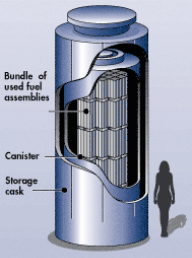
According to the U.S.NRC, potential health risks from loading and storing used fuel dry casks are very small. There have been no radiation releases affecting the public from these systems since casks were first loaded in 1986.
Myth: Nuclear plants are not prepared for emergencies.
Nuclear facilities are built with multiple layers of safety, including backup systems, rigorous inspections, and emergency preparedness plans overseen by federal regulators and industry experts. Plants conduct regular emergency drills with local, state, and federal agencies to ensure coordination and readiness. Operators are highly trained and must meet strict certification requirements. These overlapping safety measures are designed to prevent incidents and protect the public in the unlikely event of an emergency.
[1] https://www.nei.org/fundamentals/safety
[2] https://www.nei.org/resources/fact-sheets/safety-nuclear-energy-industry-highest-priority
[3] https://www.nrc.gov/reading-rm/doc-collections/fact-sheets/storage-spent-fuel
[4] https://www.nrc.gov/waste/spent-fuel-storage/diagram-typical-dry-cask-system
[5] https://www.energy.gov/ne/articles/5-fast-facts-about-spent-nuclear-fuel